Showing posts with label National Curriculum. Show all posts

Thursday, 14 February 2013

Friday Reflection!

Winter's Final Blast!


A week of extremes, Monday wintry again and snow.  Thursday (today) and we have torrential rain,  flooding in places and 10C temperatures.   Daily commute for the last few weeks to Harlow over and done with.  an interesting experience from an educational point of view if not from the other side of the car windscreen as I travelled down a major M-way.

Academies are increasingly at the fore front of UK education.  They are the natural extension of Locally Managed Schools (LMS) and Grant Maintained Schools that were introduced as part of the 1988 Education Act.  This apparently formed the basis of the American Act of 2001 "No Child Left Behind".   The chief legacy of the English Act has been to remove schools as Academies from the control of the Local Authorities to a centralised funding model.  In other words the Department of Education now sets the funding level directly and stipulates what has to be taught.

In the wake of the launch of the new curriculum (as mentioned in last weeks blog) a period of change has been heralded again.  The National Curriculum for England and Wales was again a product of the 1988 Education Act.  Over the period since 1988 the complexity of the curriculum and the documentation has increased and decreased depending on the political wind blowing at the time. 

Teachers have had to wade through documentation and teaching resources with names such as National Frameworks and guidelines.   In the pursuit of standardisation that can be measured we have expended a lot of time and effort in the UK that other more "successful" OECD countries involved in PISA test have not. We do talk a lot about the UK's ability to compete in a global market based upon these tests.

In the 25 years since the introduction of the National Curriculum is it possible for us to have one defining document that states what we need to teach?  More importantly is it possible for us to come up with a measure of success that is understood with clarity in terms of Ofsted inspections?  Human cognitive processes have not evolved radically in 25 years.  The systems we are using to teach this generation compared to the last 25 years ago have changed.  

We could argue that the systems being used today are at fault when we become whimsical about a past educational success.   The comparisons being made are not like for like.  In 1988 it was only just coming into force that pupils had to stay until after their the 16+ exams (even this was muted as a title of that exam before GCSE emerged from the GCE and CSE qualifications).  Today we are talking again of pupils moving on from secondary school based education to UTC (University Technical Colleges) at the age of 14.  "School leaving age" or compulsory education and training is gradually rising to 18 in the next two years.  Having a National Curriculum to age 14 makes sense.  What happens after is still controversial in that GCSEs are being "reformed".  Whether this will lead to improvement in competence as opposed to league table positions is the big question.  We need to have more of a pass or fail test of competence in key skills such as Maths and English for the majority of pupils.  The academic requirements of A, B grades for college entry are a different arguement possibly from a certification of competence in skills that can be used in the workplace.  Should we even be considering that a measure at age 16 should dictate life pathways? 

As you have probably gathered from this blog I am having difficulty understanding which way the UK Education is going.   The key question is  if the current stirring of the educational cauldron will achieve the goal of providing UK's (or those in England and Wales) young adults and therefore future decision makers with the skills to make informed choices?  Or are we again becoming embroiled with how complex can we make the dream machine?  Or do we need to go back and sit under a tree and just listen and converse?  Did it work for the Ancient Greeks?  We do not know as they were not PISA tested against other countries, but we do know that their legacy of literature is still used.  Will we say that about the 1988 Education Act in a similar vein of contemplation?


Saturday, 9 February 2013

Friday Reflection!

UK Education changes!

+Philip Spalding

A major week for educational announcements!  The Ebacc that was is not to be (http://www.bbc.co.uk/news/uk-21363396).   The much needed re-establishment of confidence UK education qualifications took another twist as stakeholder groups had their input taken on board.  As usual there were claims of U-turns on policy.  This negative phrase goes back to the Mrs. Thatcher declaration the "Lady is not for turning".  Since this time reversals of thinking have become even more associated with failure rather than compromise.  We try to teach children in school is tolerance, considering the other persons point of view, weighing up evidence and making decisions based on a balanced view.

Parliament and politicians reinforce the idea that one individuals opinions are either wholly right or wholly wrong.  In a complex issue such as educational qualifications we have a lot of vested interests from subject experts to exam boards who publish their own textbooks to go with courses that wish to preserve the present system.  Understandable as they have been allowed to create the status quo.  The idea of market forces and demand moulding educational choices has faltered in the educational sphere under the influence  of league tables.  Innovative curricular are often shunned in schools as they take the safe route of following the materials that have all the information produced by a limited number of publishers and exam boards.  Selection of exam boards qualifications are often based on the perceived difficulty of the exam board.

A new curriculum was launched for State Schools.  Again the reporting on this issue shows the combative point scoring nature of British politics.  Academies can choose to write their own curriculum but with Ofsted judging against a fixed set criteria it would take a very brave new academy to risk being out of step. The system appears broken and needs fixing.  All parties should be working to a solution that will not be used just for one parliament. It needs to be allowed to run long enough to be effective in bringing about confidence in young people's skills.  The educational establishment needs to step back and be objective rather than protecting it's own position.  Pupils have an 11 year training period (two and a bit parliaments life times).  The effect of changes at year 5 will therefore not be seen for another 11 years by employers interested in recruiting a skilled workforce.  At the moment the pace of revision means that 16 year old pupils over a five year period can be sitting very different exams.  The GCSE is therefore not a very easy way to compare candidates for jobs and college places who span a range of interests. We have a conveyor belt of school, college jobs that rely on the same age group

The question has to be asked who are the GCSEs actually for, the schools or the pupils who have to enter the stage of their life.  Are they fit passports for a modern society?  Should basic qualifications in English, Maths and Sciences be sat at 16?  Why not 14? We used to test at this age.  The system was scrapped not so much because it did not give a good judgement of skills but because the system collapsed due to a marking fiasco.  With the growth of University Technical Colleges and apprenticeships the need for large Secondary schools delivering academic qualifications to the age of 16 is disappearing.  With the raising of the formal school leaving age to 17 this summer and 18 the following year makes the qualification sat at 16 as a test at school leaving age irrelevant.

The impact of e-learning has not been considered in the new curriculum other than introducing computing as a subject instead of ICT (Information Communication Technology).  As a former head of ICT (and Science first) I have always considered ICT to be a tool and not a subject.  To be simplistic presentation and communication tools such as PowerPoint and  Word should be taught and USED in English.  Spreadsheets taught and USED in Maths and Science.  Use of YouTube and social media taught and USED in Languages which to my thinking does include English (or Communication as it is now titled in some schools), for that matter we should use languages in other subjects as science as well.  Design and CAD packages used in Resistant Materials (this used to be woodwork and metal work) and design subjects.  Where computing will fit has not been stated.  In the EBacc it was to be the fourth science.   Should it be part of Maths?  Do we have the science teachers (who generally biologists in the UK) who can deliver coding in two languages, one of which is text based?  Are we going to have a Scratch and Python literate (Python is available for the Raspberry Pi) school population?   Are we going to have e-texts and BYOD (bring your own devices) for the classroom?  Can school networks cope with 950 or more Wi-Fi connected devices?  Does education have to involve all pupils being in a building at once if e-learning is embraced?

A fundamental question of education's future has been the overriding theme in the news.  My own little project of the Haverhill Online Learning Community (HOLC) has been gathering viewers locally this week with the Local History Week.  I have had a lot views of the timeline and some expression of interest, converting this into active members is again the challenge.  I have had a good meeting with the local MP, who is also Minister of Skills and can be seen pictured sitting next to Michael Gove in this article,  for advice and publicity.  Watch this space for further developments.  Next week  HOLC  is engaged in a little Urban Gardening  which will feature in the Blog   and on the Website.

I will also have to find some time to re-engage with all the Google+ Communities.  Full time teaching in Harlow for the past four weeks has been instructive on some levels for gathering pupil's opinions on use of Tablets and how they see the education they are receiving preparing them for later life.  However, there are not enough hours in the day looking forward to finishing this assignment next Thursday and working a bit closer to home! Have also to buy new devices this week, HP netbook and Kindle have all died!  Looking to go as much Linnux, Chrome and Android as possible, but will still need one windows based Laptop unfortunately.  Expensive times!

Wednesday, 14 November 2012

Can the Individual in the room please sit down?

A Personal Reflection of Trends in perception of the Learner in UK Education

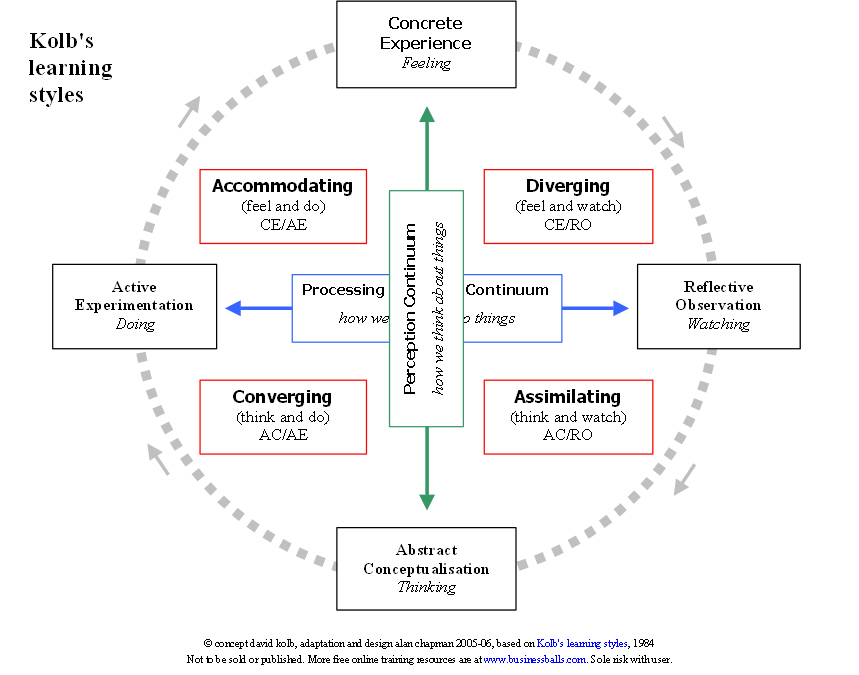
A look at the diagram to the left show's a mainstay of what has been part of British Education practice for a number of years.  The use of Learning Styles has been part of CPD in English schools through out  the drive of the implementation and improvement of the national curriculum towards individual learning. 

I have personally received many photocopied transcripts of how we should tailor individual learning plans to the student.  The idea that everybody learns differently has been an unwritten law (as opposed to theory).  Tailoring the learning process to individual perceptions of how they learn has passed into educational aspiration and often Ofsted criteria.  

A few years ago in the institution that I worked in one of the first lessons of the year in PSHE (Personal, Social and  Health Education) was to survey the pupils and decide with them which Kolb learning style they fitted into.  They were then instructed to write it down in their planner.  The grand scheme was to gather the data together at school level to inform teaching and shape individual learning experiences.  The staff were informed for a few weeks after that senior staff would be making drop-in visits to classes and asking children if they knew their individual learning styles.  Ofsted then came and went.  The effort to pursue the Individual Learning Plan along the Every Child Matters and every child is a child with special needs was somewhat lost in the mist.

The idea of Thinking skills  has been part of supportive Science teaching for a few years through CASE (Cognitive Acceleration for Science Education).  A similar project CAME has been formulated for a few years.  The basis of the work is the theories of Piaget and Vygotsky.  The CASE approach, which I have taught myself, is a set of activities teaching skills in addition to present national curriculum.  It does produce results in improving  thinking skills.  However, the difficulty in quantifying thinking skills and Piagetian levels against the framework of the national curriculum has been difficult.  The difficulty is such that time investment in  developing these critical skills is not pursued since they do not appear  to add any intrinsic to data that feeds into league tables.

The focus on thinking skills has also briefly seen an interest in Edward De Bono's Six Hats  (apprently used by the British Civil Service).  Again this was a CPD fashion at one point (along with later Emotional Intelligence) but we did need to have a bigger hat  stand at the time to be able store the new apparel. Thinking skills is still a topic kicked around on the pitch of English educational thinking.  I am trying to be neutral and to stress the benefits.  However, as has happened with the reactive nature of the way the National curriculum has developed there is never enough time to see the final result.  There appears no willingness for a second half (to continue the analogy) or the extra time goal  that makes all the effort worthwhile.  The analogy of rolling the rock to the top of the hill springs to mind. Pausing half way up for a little bird (as in a little bird told me something else) to sit atop the rock.  The rock starts to roll back down the hill with the added information.

So what has prompted this lurch through the potted history of UK educational thought in the last 15 years (yes only 15 years)?   I read an article on the BBC website reporting the Education Ministers' Michael Goves' intention to speak at a conference on Wednesday (today).  In the article we are informed that the major influence on Michael Goves' thinking comes from Dan Willingham,  a cognitive scientist.  The main thrust of his work proposes that Learning  Styles do not actually exist.  Dan Willingham's book  "Why Don't Student's Like School?" will be worth reading to see the road map for education up to 2015 and beyond.  Personally I think, he could have thought of a better title since the implication is that at the moment all pupils do not like school.  However, this does reinforce the natural English reaction to education promoted by media to a large extent.            

The reaction to the speach will be interesting to know later today.  The fact that a cognitive scientist is becoming an influence is encouraging.  How this fits with the drive to instil knowledge compared to understanding will be an interesting path to follow!

How the idea of their being no Learning Styles affects Online Learning and Open Learning Communities is an area for further exploration.