Showing posts with label Learning Styles. Show all posts

Thursday, 15 November 2012

Friday Reflection

Treading Water!

The Friday reflection has come round again, well Thursday evening. It is Friday already somewhere in the world. Have been having a bit of week of treading water.  A week of considering whether that hillock is the top of the mountain or only anthill that could have been avoided without disturbing the occupants.

To start off with, something that I have learnt this week.  I found out when  reading and posting to Google+  that there was a hump day.  Being in the UK I was a little puzzled.  Camel support day?  But I was politely informed it was Wednesday by another name.  So over the hump I went.

I have had a little review my own personal experiences of completing courses and lack of engagement afterwards.   This led me to conclude that there is a place for the Everlasting Class to become a new forum for professional dialogue.  A Networking opportunity not limited by geographical boundaries.  In a small country like the UK relatively short distances with congested infrastructures are such barriers.  Google+ Hangouts  can be a solution.  I was unable to attend a local meeting of Best of Haverhill , owing to a few conversations via mobile phone, discussing a very worthy topic of reconnecting Haverhill back to the railway.   We had our rail link removed nearly 47 years ago in a so called rationalisation.  In my apologies for absence on the Best of Haverhill Event Facebook page I suggested that a Google+ Hangout or YouTube channel broadcast would be ideal for small business owners to be informed of such an important topic. We will see what comes of that.

On Wednesday (my Hump day apparently)  I blogged on the topic of the changing mantras of UK education.  The article that prompted my meandering  was  thought provoking as it gave insight on the influences of our current Minister for Education.  The book that he was most influenced by according to the article promoted the ideas that there were no individual learning styles.  That rigorous testing was good for the development of learners and should be the norm.  Without having read the book yet I am not in a real position to comment (sitting on the fence?).  I haven't found a Kindle version of the particular book.  Amazon  do have it for sale in print version.  However, I predict that that the book may be a mini-bestseller as every Head Teacher, Deputy Head and journalist will clamour to buy a copy in a bid to understand the future path of education in England and Wales (Scotland has it's own apparatus for mass education).

After one of the pillars educational thought had been questioned how did this affect my perception of Open Learning Communities (OLC also stands for Online Learning Communities).   A reference to the Royal Society in Tuesday's blog and it's origins prompted a comment from one collaborator of the Bank Street OLC.   The  original format for Royal Society meetings was a kind of "show and tell".  He was interested how this element could be introduced into Google+ Hangouts.  Smartphones were mentioned as a possible tech solution.  The new Nexus range launched this week could be in the part of the enabling technology.  Especially if there are front and back mounted cameras that can work independently in separate Hangout Windows.

So how did I do with the plans for this week.  Well I have edged a bit further along the path to coding and producing a Google Course Builder application.  Still a little way off.  Have to catch up with the edX and ALISON courses. Did use Study Room   for the edX course.  Interesting experience, a bit like a game navigating the Avatar to interact with other students.  Have not yet blog posted the updated Virginia Tech thoughts.  May look at the context again to see if it is Learning Style independent.  First thoughts are that it is since it works on the student-instructor continuum.

So for next week.  I will look at how OLC could be set up in the local area for Haverhill and float some ideas.  The coding courses really need to be caught up with and put back on track.  Long Term plan may need to be completed!

Well just about cat is in front of fire.  One side is done the flip side soon to happen.  Think I will join her next to the fire as it starting to become very wintery in Suffolk!  

Wednesday, 14 November 2012

Can the Individual in the room please sit down?

A Personal Reflection of Trends in perception of the Learner in UK Education

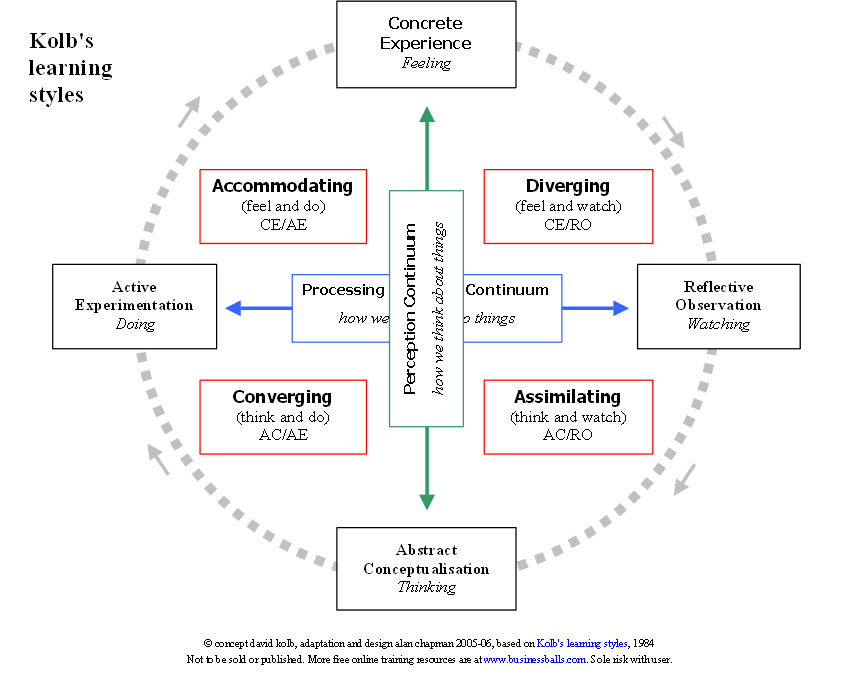
A look at the diagram to the left show's a mainstay of what has been part of British Education practice for a number of years.  The use of Learning Styles has been part of CPD in English schools through out  the drive of the implementation and improvement of the national curriculum towards individual learning. 

I have personally received many photocopied transcripts of how we should tailor individual learning plans to the student.  The idea that everybody learns differently has been an unwritten law (as opposed to theory).  Tailoring the learning process to individual perceptions of how they learn has passed into educational aspiration and often Ofsted criteria.  

A few years ago in the institution that I worked in one of the first lessons of the year in PSHE (Personal, Social and  Health Education) was to survey the pupils and decide with them which Kolb learning style they fitted into.  They were then instructed to write it down in their planner.  The grand scheme was to gather the data together at school level to inform teaching and shape individual learning experiences.  The staff were informed for a few weeks after that senior staff would be making drop-in visits to classes and asking children if they knew their individual learning styles.  Ofsted then came and went.  The effort to pursue the Individual Learning Plan along the Every Child Matters and every child is a child with special needs was somewhat lost in the mist.

The idea of Thinking skills  has been part of supportive Science teaching for a few years through CASE (Cognitive Acceleration for Science Education).  A similar project CAME has been formulated for a few years.  The basis of the work is the theories of Piaget and Vygotsky.  The CASE approach, which I have taught myself, is a set of activities teaching skills in addition to present national curriculum.  It does produce results in improving  thinking skills.  However, the difficulty in quantifying thinking skills and Piagetian levels against the framework of the national curriculum has been difficult.  The difficulty is such that time investment in  developing these critical skills is not pursued since they do not appear  to add any intrinsic to data that feeds into league tables.

The focus on thinking skills has also briefly seen an interest in Edward De Bono's Six Hats  (apprently used by the British Civil Service).  Again this was a CPD fashion at one point (along with later Emotional Intelligence) but we did need to have a bigger hat  stand at the time to be able store the new apparel. Thinking skills is still a topic kicked around on the pitch of English educational thinking.  I am trying to be neutral and to stress the benefits.  However, as has happened with the reactive nature of the way the National curriculum has developed there is never enough time to see the final result.  There appears no willingness for a second half (to continue the analogy) or the extra time goal  that makes all the effort worthwhile.  The analogy of rolling the rock to the top of the hill springs to mind. Pausing half way up for a little bird (as in a little bird told me something else) to sit atop the rock.  The rock starts to roll back down the hill with the added information.

So what has prompted this lurch through the potted history of UK educational thought in the last 15 years (yes only 15 years)?   I read an article on the BBC website reporting the Education Ministers' Michael Goves' intention to speak at a conference on Wednesday (today).  In the article we are informed that the major influence on Michael Goves' thinking comes from Dan Willingham,  a cognitive scientist.  The main thrust of his work proposes that Learning  Styles do not actually exist.  Dan Willingham's book  "Why Don't Student's Like School?" will be worth reading to see the road map for education up to 2015 and beyond.  Personally I think, he could have thought of a better title since the implication is that at the moment all pupils do not like school.  However, this does reinforce the natural English reaction to education promoted by media to a large extent.            

The reaction to the speach will be interesting to know later today.  The fact that a cognitive scientist is becoming an influence is encouraging.  How this fits with the drive to instil knowledge compared to understanding will be an interesting path to follow!

How the idea of their being no Learning Styles affects Online Learning and Open Learning Communities is an area for further exploration.